
As we’re starting to wrap up 2024, we’re having a lot of discussions internally and with our clients about “what’s next” and what to expect for 2025.
With an eye on the future, we’ve put together a list of 2025 digital marketing trends that are likely to impact businesses in the year to come. We’ve found that many of the “trends” we’re seeing aren’t really new. In fact, a lot of them are just building over time and becoming more of a priority.
As you put together your 2025 marketing strategy, understanding these trends and what’s to come can help you spend your marketing dollars wisely and see more results for your business.
Increased Personalization
Personalization is going to become more important than ever — but it’s more than just adding a customer’s name to an email subject line. That’s the baseline. Personalization today means using data to deliver truly relevant and tailored experiences.
Using personalization to deliver the right message at the right time can help you enhance customer loyalty and drive conversions in 2025.
What this means for businesses:
Your business needs to leverage data — such as past purchases, browsing behaviors, and predictive analytics — to create personalized experiences across email, ads, and SMS. For example, use customer browsing data to send personalized emails featuring products related to a recent purchase or showcasing the customer’s favorite color or style.
More Integrated Offline and Online Experiences
We’ve seen the lines between offline and online marketing blurring for years. Customers — especially younger customers like Gen Z — no longer distinguish between online and offline interactions.
As we head into 2025, businesses that can offer a unified experience across touchpoints will engage more customers and see increased success.
What this means for businesses:
Find engaging ways to help customers seamlessly transition between the digital and non-digital worlds. Strategies like direct mailers, QR codes, text messages, and virtual reality can help customers bridge the gap.
With direct mail retargeting, you can send a customized postcard to people who previously visited your site. Including multiple points of contact — such as your phone number, email, and a QR code link to your site — allows recipients to re-engage however they prefer.
Rise of AI-Driven SERPs
We saw them take over in 2024, and AI-generated search results will continue to grow. We predict AI results will expand from informational queries into commercial and local queries.
Since Google prioritizes its advertisers, we may also start to see ads in these AI results as well.
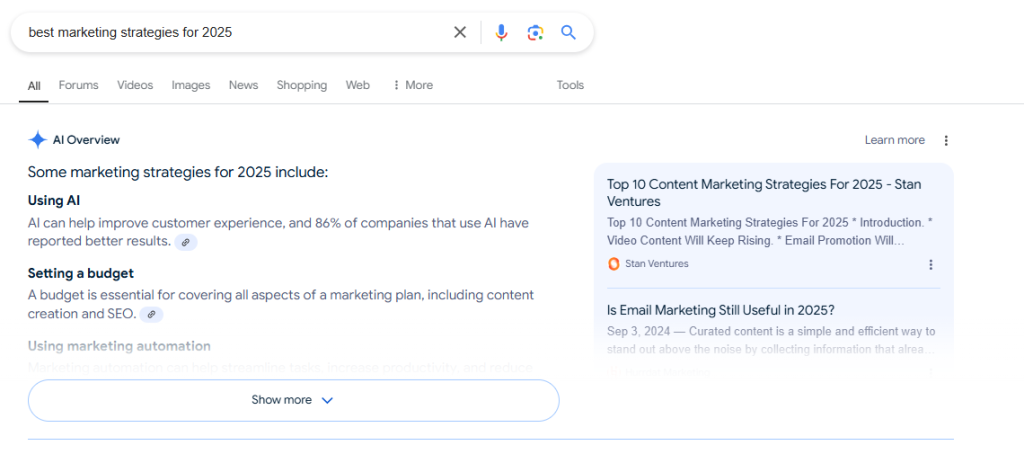
As search generative AI grows, clicks through to your website will continue to decline as users get answers directly on the search engine results page (SERP).
What this means for businesses:
Go all in on quality rather than quantity. By providing insights beyond what AI can recommend, you may still see some traffic declines but site visitors will probably be more qualified and further down the funnel.
“With less clicks to the website, I think it will be important to focus on the quality of the traffic coming to the website and not just the amount of traffic. AI overviews will almost sift through low-quality traffic and searchers farther down the marketing funnel who visit your website may be more likely to convert.”
— Lexie Buhrandt, SEO Specialist at E-Power Marketing
Businesses should also diversify content types by including video, interactive tools, and other visual media that draw users to their site and provide more opportunities to draw customers in from search results.
Social Media IS the Internet
Social media continues to evolve into an all-encompassing space where users search, shop, and interact with brands directly. With more than 5 billion social media users worldwide, social media will only become more central to the buyer’s journey in 2025 and the years to come.
Social media platforms like Facebook, Instagram, YouTube, and TikTok are key to brand discovery and revenue generation for customers of all ages. In fact, the number of consumers using TikTok to find information about products and brands has tripled since the end of 2020.
What this means for businesses:
First and foremost, if you’re not investing in your social presence, you should be.
Focus on community-building to deepen connections with followers. Treat social media like any other customer service channel (phone, email, etc.), promptly answering questions and messages and proactively engaging with your customers.
Take full advantage of all the features social media has to offer. That means utilizing in-app shopping or sign-up features to generate leads and revenue and sharing content to drive traffic back to your site.

Consumer Trust is Paramount
In an age of fake AI information, customer data privacy issues, and online scams, building trust with customers is going to be more important than ever as we head into the new year.
Brands need to go above and beyond to protect data and reassure customers they’re safe and secure when interacting with you.
What this means for businesses:
While there’s a lot you can do to improve security, start with transparency. Be open about data collection and usage, employing practices like double opt-in for email and SMS and clearly showcasing privacy policies. Work with your legal team and IT experts to make sure all processes are compliant.
Next, feature trust signals throughout your marketing efforts. That could include adding return and warranty information to your product pages, adding security badges and certifications to your site, and showcasing authentic customer reviews or testimonials.
All these strategies minimize risk and help signal to customers that your company and products are legitimate.
“In today’s digital landscape, every measure taken to build trust is an investment in long-term loyalty and brand credibility.”
— Emily Miels, Inbound Marketing Strategist at E-Power Marketing
Continued Rise of Voice Marketing
With 142 million voice assistant users in the United States, voice-activated devices like Amazon Alexa and Google Home are the norm in homes, offices, and vehicles. As this market is only expected to keep growing, voice marketing is a crucial channel to consider in 2025.
What this means for businesses:
“As Alexa and Google Assistants become more and more prevalent, make sure your content and emails are easily readable by voice-assistants to help your brand stand out.”
— Kayde Kempen, Account Strategist at E-Power Marketing
As you create new content and optimize existing content, focus on frequently asked questions, natural-sounding language, and local search terms. Short sentences and bullet points can also make it easier for devices to read.
Further AI Support & Optimization
AI tools like ChatGPT have been all the buzz in 2024. As we move forward, we’ll see AI continue to improve efficiency and performance across the board for ads, content, and other marketing creatives.
As these tools become more widely used and technology advances, we’ll likely see AI continue to outpace humans — whether that’s more natural and engaging writing or improved optimization for ad campaigns.
What this means for businesses:
Your company, particularly marketers, need to understand how the tools and systems you use work so that you can identify issues and step in as needed. Research tools and set company policies and processes to ensure safety, accuracy, and reliability.
As you’re working on your website and other marketing assets, you should focus on E-E-A-T signals — expertise, experience, authoritativeness, and trustworthiness. This includes things like adding in quotes, data, personal narrative, and more. These have been a cornerstone of Google’s quality guidelines for years and help you go beyond what generative AI tools can create on their own.
Video, Video, Video
Video is obviously not a new trend, but it’s consistently growing as the preferred content format for ads, social, etc. year after year. Videos can relay information in an engaging way, increasing awareness and moving your customers through the funnel.
“Video is particularly important on social media platforms, as creators are trending toward videos rather than graphics.”
— Andi Thiel, Digital Advertising Strategist at E-Power Marketing.
What this means for businesses…
It’s time to invest in video if you’re not already.
Depending on your marketing strategy for the new year, that could look like investing in large-scale production or DIY tools like a tripod and microphone for higher-quality video right from your office. It could also mean testing new video tactics, lengths, and CTAs to help hook viewers and hold attention.
Beyond creating your own videos, look for unique ways to incorporate and repurpose user-generated videos and influencer video content into your marketing tactics. AI can also help you speed up the video planning, editing, and distribution process.

Simplification is Key
As the digital landscape becomes more crowded and budgets tighten in 2025, you can’t be everywhere and tackle every trend or platform. Focusing on a few core marketing goals and setting a clear 2025 digital marketing strategy can help you get the most out of your marketing campaigns and resources.
What this means for businesses:
Before you dive in for the year, take some time to define clear, attainable objectives that are aligned with your target audience’s needs. Avoid spreading limited resources across too many channels.
Once you’ve done that, prioritize your marketing objectives. That way, every message and deliverable aligns with your overall strategy and gives you the most bang for your buck.
Stay Ahead of the Curve With E-Power
Our experienced team will help you navigate all the 2025 trends with a flexible marketing strategy and transparent, no-fluff reporting for strategic business decision-making. Let’s get you the results you deserve in 2025.